This article is a translation of the original Finnish article: Vesi-ilmalämpöpumppu – kaikki mitä sinun tarvitsee tietää
Air-to-water heat pump – everything you need to know
· updated
An air-to-water heat pump (in Finnish vesi-ilmalämpöpumppu, or more officially ilmavesilämpöpumppu) is a building services device that transfers heat from the air into water – a so-called “air-to-water heat pump”. Its energy efficiency shows up as lower energy costs and also as a lower E-value (E-luku) in the building’s energy performance certificate (energiatodistus). The abbreviations VILP (vesi-ilmalämpöpumppu) and IVLP (ilmavesilämpöpumppu) are used in Finnish. It should also be noted that in this text all these terms are understood as synonyms, even though in some very rare case vesi-ilmalämpöpumppu could refer to transferring heat from water to air. In buildings, an air-to-water heat pump is connected to a water-based (hydronic) heating system – most often a radiator network or an underfloor heating system – and to domestic hot water production. It is technically possible, and perhaps even worthwhile, to use the device to heat the supply air as well, if the ventilation unit has a water-based post-heating coil. In smaller residential buildings, however, water-based post-heating coils in the ventilation are probably almost never found. You sometimes also hear of swimming pools being heated with an air-to-water heat pump, which can indeed be a very energy-efficient solution. Outdoor pools are, after all, presumably heated in summer, when the air is warm and heat pumps operate at particularly good efficiency. In this article we go through the operating principle of the air-to-water heat pump, explain the key terms (SCOP, COP, etc.) and tell you which performance figures are worth looking at in these devices. Energy consulting is useful when considering which energy efficiency solution is the most cost-effective for a particular building.
Air-to-water heat pump – operating principle
The operating principle of an air-to-water heat pump is shown in the figure below. Air-to-water heat pumps, and heat pumps in general, work because refrigerants change their state at low temperatures. For example, the boiling point of the refrigerant R410A (now being phased out) at normal atmospheric pressure is -48.5 °C. Another important factor in how heat pumps work is the energy that is absorbed or released when substances change state. When the refrigerant evaporates at the low pressure of the evaporator, it absorbs energy from its surroundings, so the outdoor air from which the energy is taken cools down. Correspondingly, when the refrigerant turns from gas into liquid in the condenser, energy is released into the surroundings, so the surroundings – in the case of an air-to-water heat pump, the water being heated – warm up.
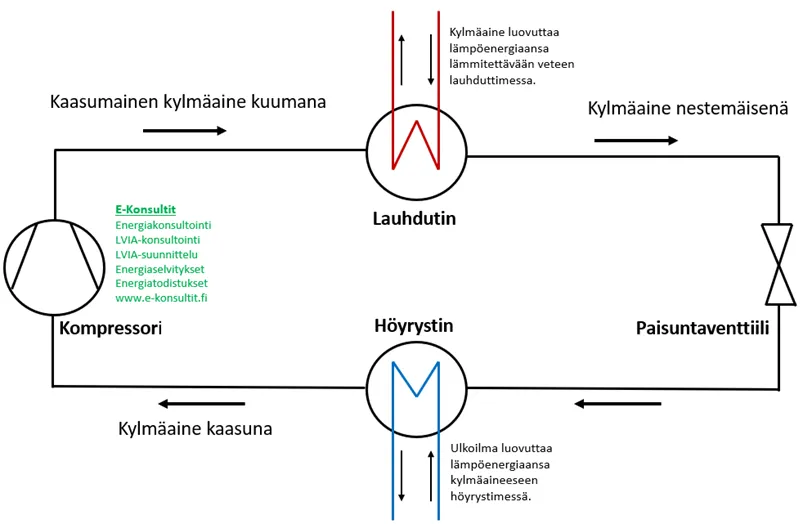
Figure illustrating the operating principle of an air-to-water heat pump. The refrigerant circulates in the system from the condenser to the expansion valve, from the expansion valve to the evaporator, and so on.
Expansion valve
The expansion valve receives the refrigerant returning from the condenser, which at this stage is at high pressure and in liquid form. The expansion valve’s “passage” for the refrigerant is smaller than in the refrigerant pipe before it, so the refrigerant passes through the smaller opening at an increased flow velocity and the pressure drops, which also cools the liquid refrigerant.
Evaporator
The evaporator is located in the outdoor unit of the air-to-water heat pump. In the evaporator the refrigerant evaporates as heat energy from the outdoor air transfers into it. In an air-to-water heat pump, operation is boosted by a fan that replaces the air – which transfers heat energy to the refrigerant and cools in the process – with new, warmer air.
Compressor
When the refrigerant arrives at the compressor it is a gas, but a relatively cool one. The compressor raises the pressure, as a result of which the gaseous refrigerant heats up and continues towards the condenser.
Condenser
The condenser is located in the indoor unit of the air-to-water heat pump, i.e. where the water being heated collects its heat energy. The refrigerant arriving at the condenser is at high pressure and hot. In the condenser of the air-to-water heat pump, the hot gaseous refrigerant gives off its heat energy to the water being heated, cools and turns back into liquid.
Refrigerant
A refrigerant is a substance whose properties suit the operation of heat pumps. Refrigerants change state at low temperatures. Some of the refrigerants used in the past are now banned because of their toxicity or their effect of depleting the ozone layer. Attention has now also started to be paid to their effect of accelerating climate change.
Energy needed for a change of state
When a substance changes state, a significant amount of energy is absorbed or released without the temperature of the substance even having to change. Let’s take a familiar substance, water, as an example. To heat a kilogram of water from 0 °C to 100 °C, we need approx. 420 kJ of energy. The energy needed for a temperature change of one degree is therefore approx. 4.2 kJ. If we then want to turn the 100 °C water into 100 °C steam, we need an additional 2260 kJ of energy. The change of state alone therefore absorbs a surprisingly large amount of energy compared with heating the substance when its state does not change.
Electricity consumption of an air-to-water heat pump and the key performance figures
The electricity consumption of an air-to-water heat pump depends, among other things, on its COP (Coefficient of Performance) and SCOP (Seasonal Coefficient of Performance) values. The higher the COP and SCOP values, the smaller the electricity bill of the air-to-water heat pump. The efficiency of the device is affected both by the outdoor air temperature and by how warm the water being heated needs to be. The hotter the water needs to be heated, the bigger the electricity bill. The colder the outdoor air, the bigger the electricity bill. Electricity consumption is of course also affected by the need for heating energy.
COP value
The COP value describes the ability of the air-to-water heat pump to transfer heat energy at a given outdoor air temperature and a given temperature of the water being heated. The warmer the outdoor air and the lower the temperature to which the water needs to be raised, the higher the COP value in the stated conditions. If the COP is stated as, for example, 2 at an outdoor air temperature of 1 °C and a heated water temperature of 45 °C, one kilowatt-hour of electricity provides two kilowatt-hours of heat energy under those specific conditions. The COP value therefore always applies only to one specific outdoor air temperature and one specific heated water temperature.
SCOP value
With air-to-water heat pumps, however, the figure to focus on is mainly the SCOP value, which gives an estimate of the average efficiency at which the air-to-water heat pump operates over a year of use. It is essential to check that the device’s SCOP has been stated for the Finnish climate zone and not for some other climate zone. If the SCOP of an air-to-water heat pump is stated as 3 and your heating demand is 9000 kWh/year, you can estimate that you will only need to buy 3000 kWh of electricity (9000/3=3000). Note, however, that the SCOP value is also often only a rough estimate. For example, in water-based underfloor heating systems the supply water is often at a lower temperature than in radiator networks, so the SCOP values of the same air-to-water heat pump differ for these. It is also worth noting that the Finnish climate zone naturally cannot be the best estimate for the whole country. In the south, the actual efficiency of an air-to-water heat pump is better than in the north.
Price of an air-to-water heat pump
Prices of air-to-water heat pumps vary by quality, size, model and manufacturer. A small system, for example one intended for a detached house, can be had for just a few thousand euros, whereas air-to-water heat pumps intended for large blocks of flats or office buildings can cost tens of thousands of euros. An air-to-water heat pump system delivers energy savings compared with most alternative systems, and in many cases it can be an energy efficiency investment worth considering from a financial point of view. An air-to-water heat pump reduces the electricity bill considerably in buildings with direct electric heating, and also reduces total energy use compared with, for example, buildings on district heating.
Possible problems
Problems with air-to-water heat pumps arise in severe frost. As the outdoor air temperature drops, the efficiency of the air-to-water heat pump deteriorates, and in very severe frost it deteriorates so much that the pump no longer adds value compared with direct electric heating. In air-to-water heat pumps that use water or a water-glycol mixture for heat transfer, there may, at least in theory, be a risk of the pipework freezing and bursting in the hardest frosts, especially if the device is switched off.