This article is a translation of the original Finnish article: Energiaselvitys
Energy report
· updated
The energy report (energiaselvitys) is a set of documents required for the building permit of a new building and, in existing buildings, for a large-scale renovation. The content of the energy report varies depending on whether it concerns a new building or a large-scale renovation of an existing building. The content of the energy report also varies depending on the building’s intended-use category. At its most extensive it includes an E-value calculation, an energy performance certificate (energiatodistus), a summer-time temperature assessment and a heat loss balancing calculation. The energy calculation made for the documents required by law often serves as a good basis for the more comprehensive energy efficiency reports our company prepares, so ordering them together brings cost savings in energy consulting. In an energy efficiency report we examine which solutions would allow the housing company (taloyhtiö) or the property owner to achieve savings in energy costs. Energy efficiency reports are described in more detail at the end of this article.
Price of an energy report
The price of an energy report depends on the property’s intended-use category, the available source data and whether it concerns a new building or a large-scale renovation project of an existing building.
- Energy report for a block of flats: case by case, from 1099 €, incl. VAT.
- Energy report for a terraced house: case by case
- Energy report for a detached house: case by case
- Energy report for renovation: case by case
- Energy report for commercial premises: case by case, from 1099 €, incl. VAT.
- Other energy reports: case by case
Contents of an energy report
At a minimum, the energy report contains the key source data and results of the E-value calculation, a demonstration that heat losses comply with the regulations, and a demonstration that structural energy efficiency complies with the regulations. In many cases, however, an energy certificate (which includes the E-value calculation), a summer-time temperature assessment and a heat loss balancing calculation are required.
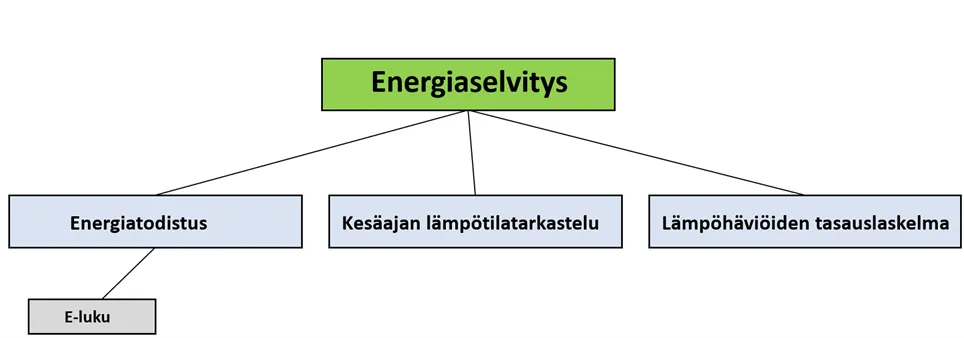
Contents of an energy report at its most extensive
Energy certificate
The energy certificate is a document of the source data used in the E-value calculation, and it also presents the results of the E-value calculation, i.e. the E-value. The energy certificate records information affecting the calculation, for example on the thermal conductivity of the walls, the electricity consumption of the ventilation system, self-produced energy generated on site, the heating system and several other things that affect purchased energy consumption.
E-value
The E-value (E-luku) is an energy efficiency figure whose calculation rules are laid down in legislation and decrees. In cases where an energy certificate is required, the E-value is presented in the energy certificate. In other cases the E-value is presented as separate information. The unit of the E-value is kWhE/m2a, and it expresses how much purchased energy, weighted by energy carrier, the building consumes per unit of floor area per year
Summer-time temperature assessment
The summer-time temperature assessment in the energy report must show that the premises do not overheat harmfully in summer. The assessment is theoretical, and the calculation mainly uses the same input values as the E-value calculation. For airflows, however, the simulation of the calculated summer-time room temperature is done with the designed airflows, unlike in the E-value calculation, where standard values are used.
Legislation and decrees stipulate that in certain rooms (e.g. living rooms) no more than 150 degree hours may accumulate in the period 1.6 – 31.8. For blocks of flats, for example, the cooling limit is 27 degrees Celsius, and degree hours start to be counted when the temperature exceeds the cooling limit. If the temperature of a room is 28 degrees for one hour, 1 degree hour accumulates. If the temperature of a room is 29 degrees for one hour, 2 degree hours accumulate, or if the temperature of a room is 28 degrees for two hours, 2 degree hours accumulate as well. Degree hours are therefore obtained by multiplying the exceedance of the cooling limit (°C) by the time (h). The cooling limit depends on the building’s intended-use category.
A summer-time temperature assessment is not required for all building types. For example, it is not required for small houses.
Heat loss balancing calculation
Heat loss balancing (calculation) is a computational procedure for meeting the requirement set for heat loss. Buildings have limits on the maximum amount of heat loss allowed. If the reference heat loss of some component (e.g. air leakage) is exceeded, it must be compensated for elsewhere (e.g. in ventilation).
The balancing calculator also sets requirements, for example, for window area in relation to the building envelope, and sets the minimum annual efficiency of heat recovery in a mechanical ventilation system.
Energy efficiency report for housing companies and other customers
In an energy efficiency report, we examine which economically profitable energy efficiency investments would be worth making in the property. Different energy efficiency investments suit different properties, and the benefits they bring vary in size from property to property. For one property a ground source heat pump system may be an excellent solution, for another an air-to-water heat pump and for a third, for example, an exhaust air heat pump. Smaller energy efficiency solutions such as solar panels may also come into question, either on their own or installed together with a heat pump system. As a welcome by-product, investing in energy efficiency in most cases also reduces the carbon dioxide emissions of energy consumption.
We provide the customer with plain-language information on the energy efficiency investment opportunities in the property and assess their economic profitability. Energy efficiency reports for buildings are our core business, and our competitive edge is quality and cost-effectiveness.
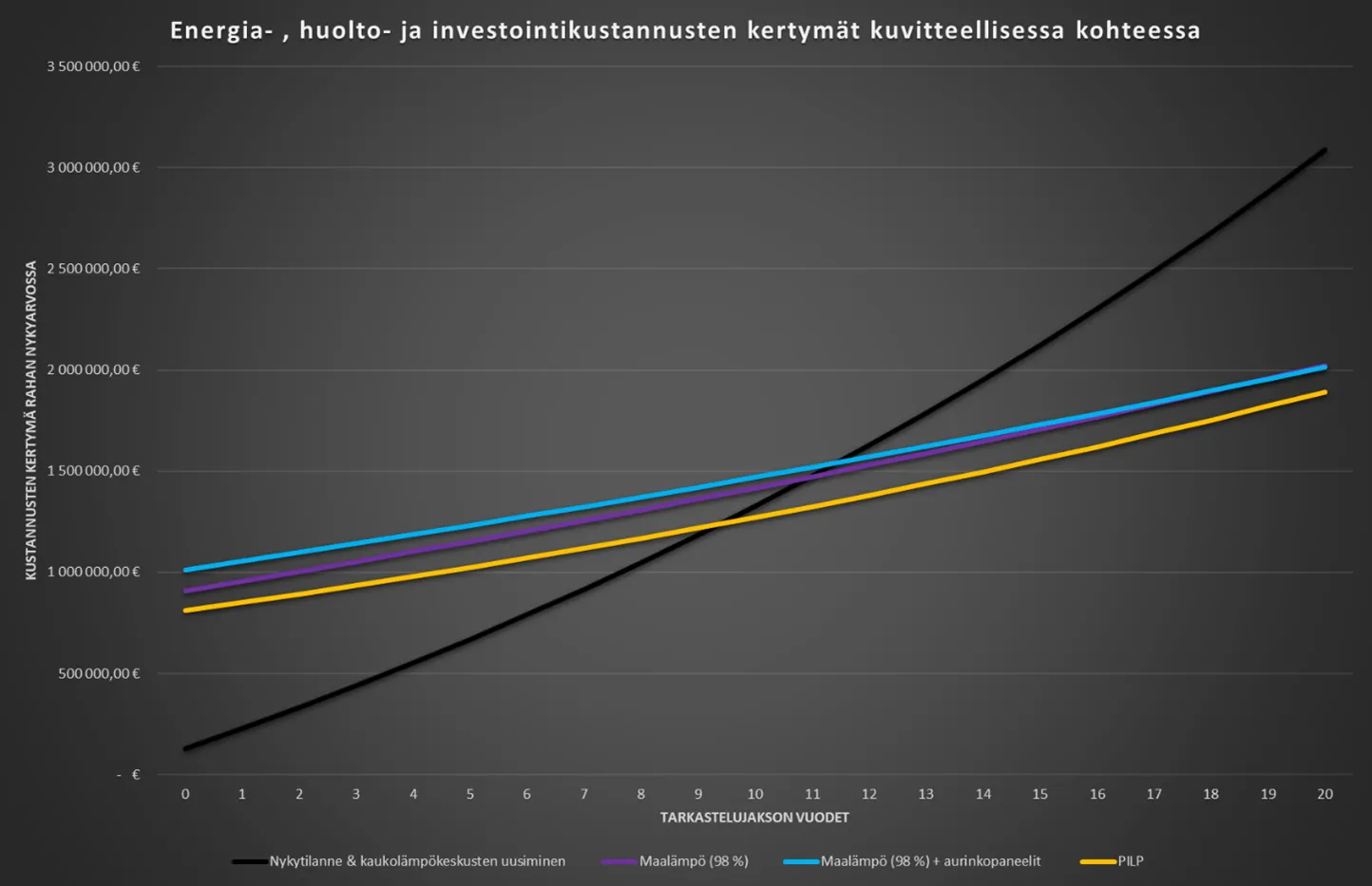
Cumulative costs of a hypothetical property with different energy efficiency solutions