This article is a translation of the original Finnish article: E-luku
E-value
· updated
The E-value (E-luku) is a comparative figure describing a building’s energy efficiency, and it can be read from the energy performance certificate (energiatodistus). A building’s E-value is obtained by dividing the building’s theoretical purchased energy consumption, weighted by energy carrier factors, by the building’s heated net floor area. E-value calculation examples have been collected comprehensively in a separate article, but in simplified terms the E-value is defined as follows: Calculated purchased energy consumption per year x Energy carrier factor / Heated net floor area = E-value. The E-value formula, or perhaps more accurately the rules for calculating the E-value, are laid down in legislation and decrees. Based on its E-value, a building is placed in one of the energy efficiency classes A–G. For new buildings there are also E-value limits, which set a minimum level of energy efficiency as a condition for obtaining a building permit. The E-value requirement and the E-value table that determines the energy efficiency class differ between building types. The customer does not, however, need to know the legislation concerning the E-value. Our company’s special expertise is precisely the preparation of energy certificates and energy reports (energiaselvitys), as well as other energy consulting such as profitability calculations for energy efficiency investments.
E-value requirements for new buildings
E-value requirements apply only to new buildings. An energy efficiency class and E-value are also determined for older buildings, but there are no requirements for them. New buildings, on the other hand, must reach at least a certain E-value, depending on the building type, in order to obtain a building permit. E-value requirements for new buildings in the different intended-use categories:
- Category 1a) Small residential buildings 50-150 m2: E-value limit 200–0.6 Anetto.
- Category 1b) Small residential buildings over 150 but under 600 m2: E-value limit 116–0.04 Anetto
- Category 1c) Small residential buildings over 600 m2: E-value limit 92.
- Category 1d) Small residential buildings, e.g. terraced houses. E-value limit 105.
- Category 2) Block of flats, at least 3 storeys. E-value limit: 90.
- Category 3) Office building, health centre. E-value limit: 100.
- Category 4) E.g. commercial building, department store, shopping centre, retail building. E-value limit: 135.
- Category 5) E.g. accommodation building, hotel, hostel, service housing. E-value limit: 160.
- Category 6) Educational building and day care centre. E-value limit: 100.
- Category 7) Sports hall, excluding swimming halls and ice rinks. E-value limit: 100.
- Category 8) Hospital. E-value limit: 320.
- Category 9) Other building, e.g. storage building, swimming hall, ice rink. No E-value limit.
In category 1a), then, the E-value limit is determined on the basis of floor area. If the heated net floor area is, for example, 100, the E-value limit is 200-0.6 x 100 =140. In category 1b), the E-value limit is also determined by floor area, but with a different formula. If the heated net floor area of a category 1b) building is 200 m2, the E-class limit is 116-0.04 x 200 = 108.
There are also some relaxations of the E-value limits based on the characteristics of buildings, and you can read more about them, the intended-use categories and the E-value requirements here (in Finnish): https://www.finlex.fi/fi/lainsaadanto/2017/1010 .
E-value factors 2018 – the updated energy carrier factors
The energy carrier factors, or E-value factors, were updated in 2018. Energy carrier factors are the factors by which a building’s calculated purchased energy consumption, as defined in the decrees, is multiplied for each energy carrier to arrive at the E-value. If, for example, a building’s annual electricity consumption is 50 kWh/m2 and its district heating consumption 70 kWh/m2, the E-value is 50 x 1.2 + 70 x 0.5 = 95 kWhE/m2 per year. The energy carrier factors currently in force are therefore (E-value factors 2018):
- electricity 1.2
- district heating 0.5
- district cooling 0.28
- fossil fuels 1
- renewable fuels used in the building 0.5
The old energy carrier factors were 1.7 for electricity, 0.7 for district heating, 0.4 for district cooling, 1 for fossil fuels and 0.5 for renewable fuels used in the building.
Calculating the E-value
The calculation of the E-value is laid down in legislation and decrees, which specify in detail what must be taken into account in the calculation. The energy certificate assessor collects information on the factors affecting the property’s energy consumption, such as the thermal conductivity of the walls, the characteristics of the ventilation system, the heating system, any solar panels and so on. Based on the collected information, the decrees and the laws, the assessor calculates the property’s purchased energy consumption, in practice always using simulation software developed for calculating energy consumption. You can read more about this in the E-value calculation examples article.
The E-value and energy saving
The E-value is a theoretical energy efficiency figure weighted by energy carrier factors, and it does not take into account, for example, varying annual weather conditions or the habits of the occupants. Even so, the E-value and the information in the energy certificate are reasonably good tools for estimating the order of magnitude of a building’s actual energy consumption, especially over the long term. The Energy saving article goes through the effects of the energy efficiency class on energy consumption and energy costs in detail, but below we have collected some examples of how the energy efficiency class determined by the E-value affects energy costs.
Effect of the energy efficiency class on energy costs in a detached house
The estimated energy consumption of a detached house with direct electric heating is shown below. Over the period examined, the energy costs of a detached house in the best energy efficiency class, A, are about 100,000 euros lower than those of one in the worst energy efficiency class, G.
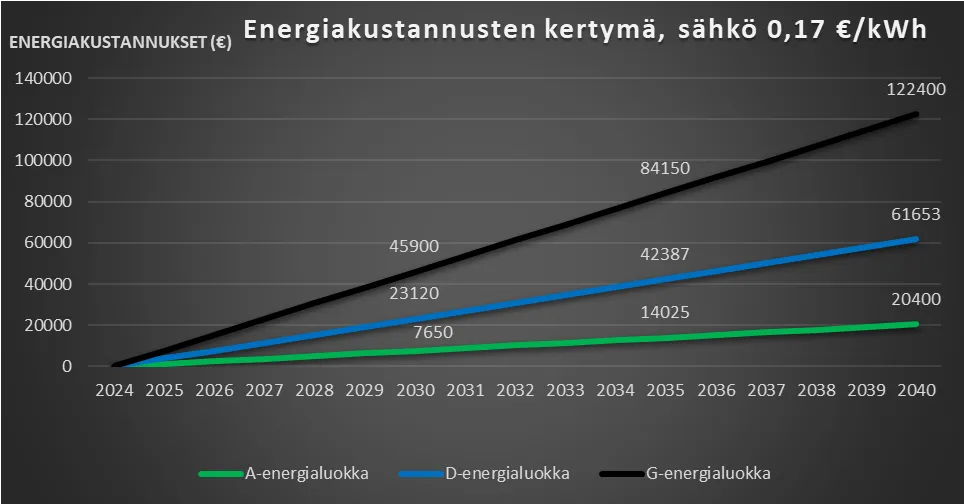
Effect of the energy efficiency class on energy costs in a detached house
Effect of the energy efficiency class on energy costs in a block of flats
Significant differences arise in the energy costs of blocks of flats in different energy efficiency classes over the period examined. The energy costs of a district-heated block of flats in energy efficiency class A are almost 1.4 million euros lower than those of a corresponding block of flats in energy efficiency class G. The building examined was a 2,000 m2 block of flats.
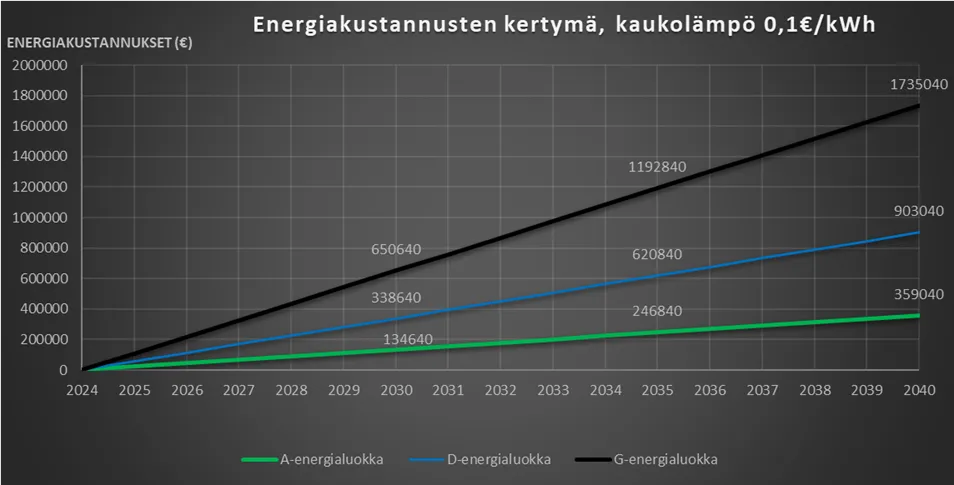
Effect of the energy efficiency class on energy costs in a block of flats