This article is a translation of the original Finnish article: Energiansäästö
Energy saving
· updated
Energy saving is a general term for measures that save energy. Most often, people are interested in how to save energy in a building. With rising energy costs and climate change, energy efficiency has become a common topic of conversation both around Finnish coffee tables and in Parliament. Energy consumption in buildings depends on the users’ habits, the weather conditions and the properties of the building itself. Users can save a significant amount of energy by, for example, taking shorter showers, but energy efficiency can also be improved without compromising on comfort, through investments aimed at saving energy. There are numerous energy efficiency measures that can be carried out on the building itself, and our company’s particular expertise lies in finding the most cost-effective energy efficiency investments and in profitability calculations. Our aim is to find the energy-saving measures, based on energy efficiency investments, that bring the client a clear financial benefit once the investment costs are taken into account. We also prepare energy performance certificates (energiatodistus) and energy reports (energiaselvitys) for all building types, and if the client so wishes, these can be combined with more comprehensive energy efficiency studies at competitive cost. Customer satisfaction and achieving real energy savings are the key goals of our energy consulting company. In this article you will find, among other things:
- Energy costs and energy efficiency class (detached house)
- Energy costs and energy efficiency class (block of flats)
- What can you do yourself at home to save energy?
Energy saving illustrated through the energy efficiency class
A building’s energy performance certificate shows its E-value (E-luku), which describes the building’s energy efficiency. Based on the E-value, the building is also given an energy efficiency class from A to G. The most energy-saving energy efficiency class is A, and the least energy is saved in energy efficiency class G.
Energy saving example 1) Detached house with direct electric heating
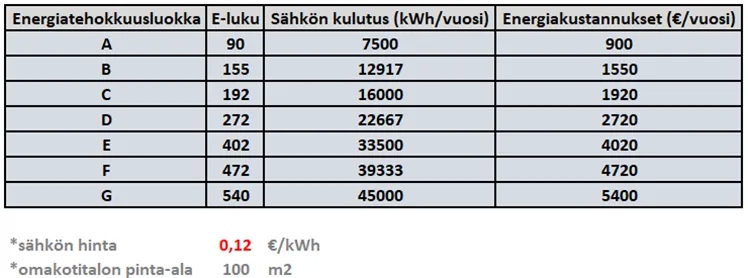
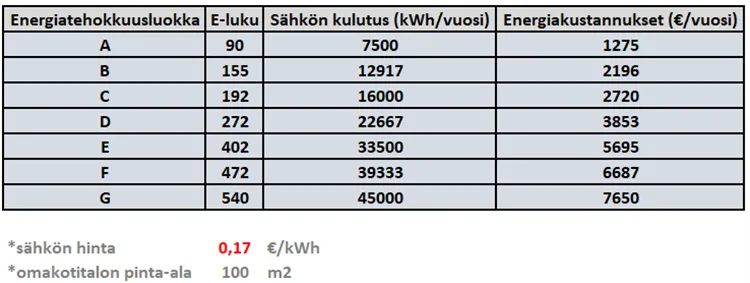
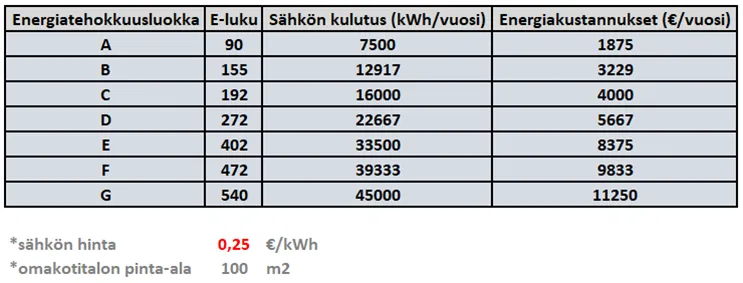
By reading the somewhat hard-to-follow energy efficiency table for detached houses, we see that a 100 m2 detached house gets energy efficiency class A with an E-value of 90. The upper limit of class B is an E-value of 155, of class C 192, of class D 272, of class E 402 and of class F 472. Class G applies when the E-value is over 472.
From the E-values we can deduce the theoretical energy consumption of the buildings. Although calculations for real buildings should take more factors into account, such as rising energy prices, in these example calculations we can simplify a little and keep the electricity price the same for the whole period under review, and the energy consumption in line with the E-value calculation rules.
Let’s do 3 calculation exercises and look at how much energy cost arises for detached houses in different energy efficiency classes over the period 2024-2040, if the price of electricity for the user is 1) 0.12 €/kWh 2) 0.17 €/kWh 3) 0.25 €/kWh. The calculations were made in 2024.
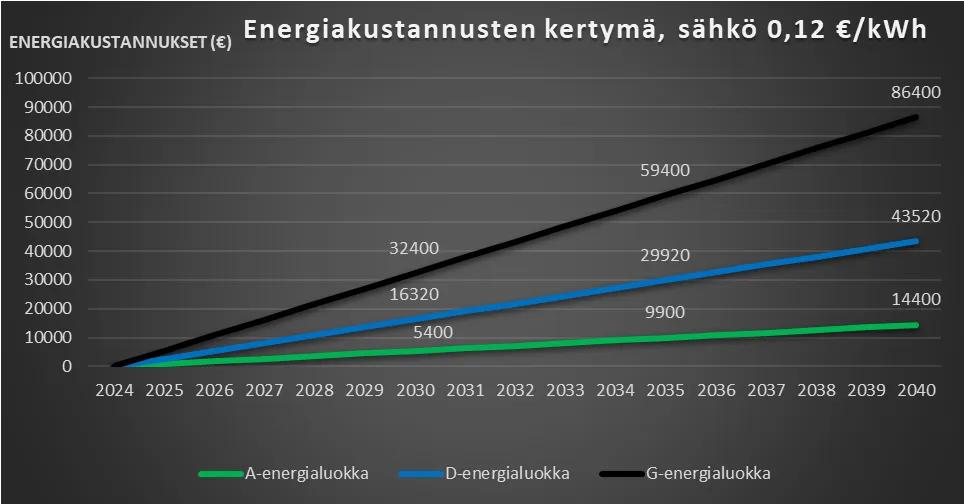
Electricity price 0.12 €/kWh, savings in the energy costs of a detached house
Even with the most optimistic, perhaps even somewhat unrealistically low electricity price of 0.12 €/kWh, the difference in energy costs between a detached house in energy efficiency class A and one in energy efficiency class G is 72,000 euros over the period 2024-2040. Every month, the class A detached house saves 375 euros’ worth of energy compared with the class G house. It is worth noting that 375 €/month is a net saving for the homeowner. At an average income level, because of progressive taxation, the energy saving raises the standard of living by roughly as much as a pay rise of over 600 €/month.
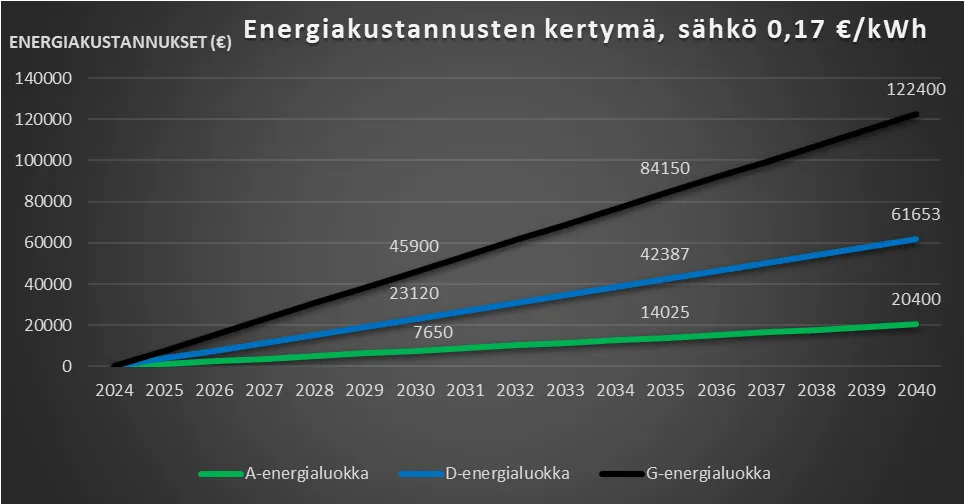
Electricity price 0.17 €/kWh, savings in the energy costs of a detached house
At an electricity price of 0.17 €/kWh, energy saving in a class A detached house brings savings of 102,000 euros over the period under review (2024-2040) compared with a class G detached house. On a monthly level, the energy saving of the class A detached house compared with the class G detached house is 531 €/month. Because of progressive taxation, for an average wage earner this energy saving corresponds to a pay rise of at least 900 €/month for disposable net income to grow by the same amount.
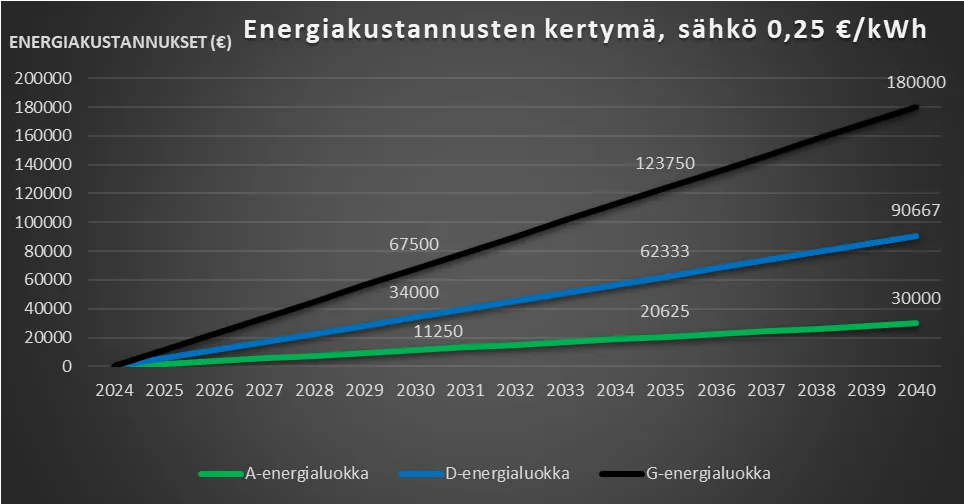
Electricity price 0.25 €/kWh, savings in the energy costs of a detached house
Let’s compare a class A detached house and a class G detached house at an electricity price of 0.25 €/kWh: the difference in energy costs over the period under review (2024-2040) is 150,000 euros. The class A detached house therefore saves 781 €/month every month compared with the class G house. Because of progressive taxation, the same rise in the standard of living would require a pay rise of over 1300 €/month.
Energy saving example 2) Block of flats heated with district heating
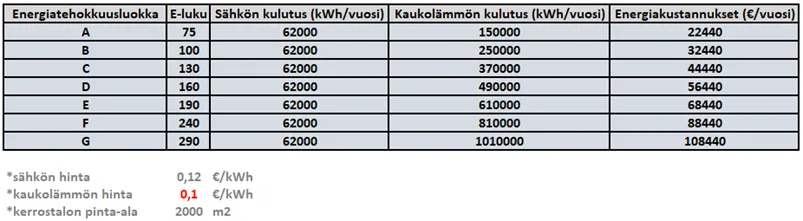
For a block of flats, the upper limit of energy efficiency class A is an E-value of 75, of class B 100, of class C 130, of class D 160, of class E 190 and of class F 240. The building falls into energy efficiency class G when the E-value is 241 or more. The block of flats in this energy saving example uses district heating and its heated net floor area (lämmitetty nettoala) is 2000 m2.
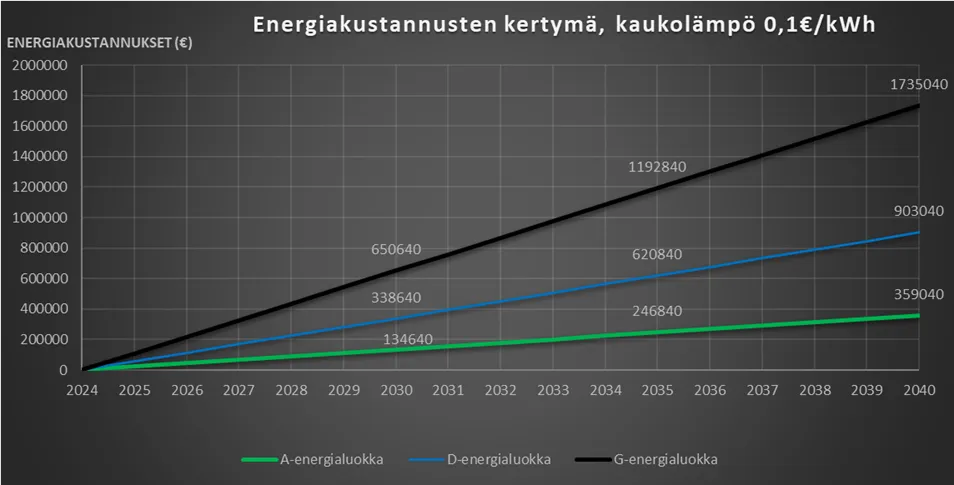
The district heating prices of one large district heating company for 2024 have been estimated to vary monthly roughly between 0.04 and 0.13 €/kWh. Prices are higher in winter, which is also when most of a block of flats’ district heating consumption occurs. In summer district heating is cheaper, but the block of flats also consumes less. Let’s simplify and set the district heating price at a flat 0.1 €/kWh for the whole long period under review, 2024-2040. When calculating a real building, you should take careful account of when district heating consumption occurs, how energy prices are expected to rise in the coming years, and so on. For an imaginary building, however, we can cut corners and still get the costs in the right order of magnitude.
Over the period under review, a class A block of flats of 2000 m2 saves 1.376 million euros in energy costs compared with a class G block of flats. For a block of flats of 4000 m2 the saving would be 2.752 million euros, and for an even larger 6000 m2 building 4.128 million euros.
How can I save energy myself?
Below we have gathered energy-saving measures that users can take themselves if they wish. The energy consulting our company provides focuses on finding the ways in which the energy efficiency of the building itself can be improved. And as the example calculations earlier in this article show, the energy-saving potential can be financially very significant when investing in the right systems that improve energy efficiency.
Venetian blinds and energy saving
When the sun shines strongly through the window during the heating season, for example in spring, it is worth keeping the Venetian blinds open. This lets the sun’s radiant energy into the home and reduces the need for purchased energy. When the sunshine weakens as the day goes on, it is worth closing blackout blinds, so that the heat-insulating blinds act as extra insulation for the window and stop heat from escaping outside.
If the home has a cooling system, energy can be saved by closing cooling blinds whenever the sun is shining even a little. This prevents solar radiation from entering the home. Venetian blinds have a considerable effect on the temperature and it is worth closing them during hot summer spells for the sake of comfort, even if they do not produce actual energy savings when there is no cooling system.
Ventilation energy saving
When saving energy in ventilation, the starting point must be that the building’s energy efficiency is not improved at the expense of the building’s service life or condition. This naturally applies both to energy-saving measures carried out by users themselves and to those carried out by contractors and designers.
Users can reduce air flows during severe cold spells, but only temporarily and within limits that prevent, for example, moisture from building up. When the air change rate decreases, energy consumption also decreases. This is above all because less new supply air needs to be heated, but to some extent also because the ventilation unit itself runs at a lower power.
Shower energy saving
The shower is the home’s energy guzzler: heating water uses a lot of energy. The heating power a shower needs depends on how much the water temperature needs to be raised and on the shower’s flow rate. A typical shower flow rate is about 0.2 litres per second and the desired or required temperature rise perhaps 20 degrees Celsius. The power can be calculated with the formula: mass flow (kg/s) x specific heat capacity of water (kJ/kgK) x temperature change (K), and the energy consumption is obtained by multiplying the power by the time.
If water at 15 degrees Celsius is raised to 35 degrees and the shower flow rate is 0.2 kg/s, the required heating power is: 0.2 kg/s x 4.2 kJ/kgK x 20 = 16.8 kW. If we assume that the shower water is heated with electricity and electricity costs 0.15 euros/kilowatt-hour, then:
- 10 min shower: 2.8 kWh and 0.42 €
- 20 min shower: 5.6 kWh and 0.84 €
- 30 min shower: 8.4 kWh and 1.26 €
- 40 min shower: 11.2 kWh and 1.68 €
- 50 min shower: 14 kWh and 2.1 €
- 60 min shower: 16.8 kWh and 2.52 €
The cooler and shorter the showers you take, the more energy you save. For example, a 10-minute shower costs 42 cents when electricity costs 15 cents per kilowatt-hour. Replacing the fitting, i.e. the shower head, with a water-saving model can also be worth considering.
Lowering the indoor temperature
Lowering the temperature of your home saves heating energy. However, the temperature must not be lowered too much, so that the condition of the home does not suffer. In frosty weather, for example, frozen pipes can lead to an expensive renovation, especially if water damage has time to occur.