This article is a translation of the original Finnish article: Laadukas energiatodistus
A high-quality energy performance certificate
· updated
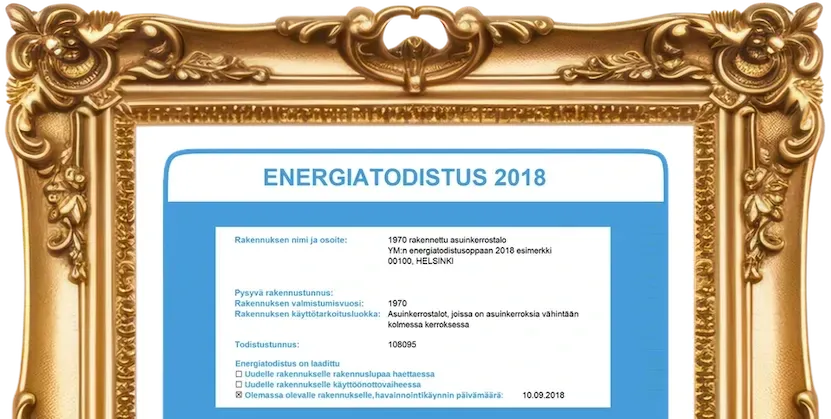
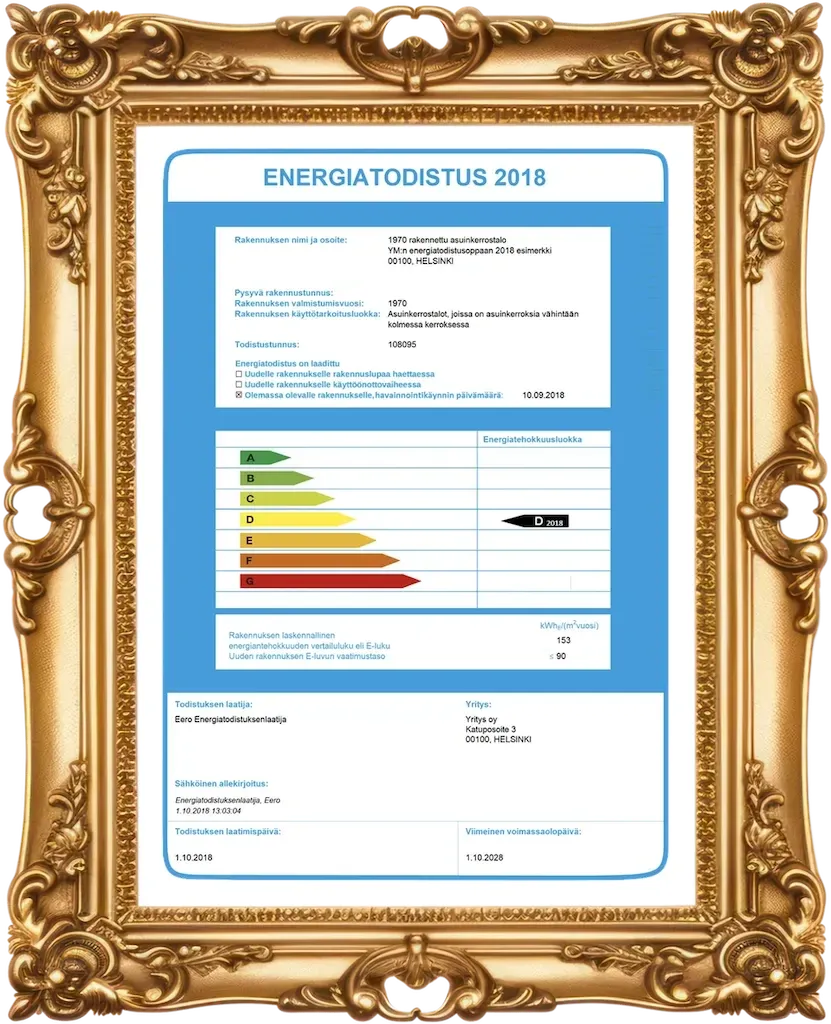
A high-quality energy performance certificate (energiatodistus) describes the energy performance of precisely the building it was prepared for. If the building is an existing one, the certificate also presents meaningful recommendations for improving energy efficiency, together with the effect of the recommended measures on the E-value (E-luku) and on the standardised purchased energy consumption.
A high-quality certificate for an existing building sets out, in plain and understandable language, the factors that affect the building’s current energy efficiency, both in its structures and in its building services systems. The calculation uses the building’s actual technical values and design values as input data, and takes into account the improvements made to the building during its life cycle that affect its energy efficiency.
A high-quality energy certificate guarantees the building owner that the building is valued truthfully in terms of energy efficiency, by potential buyers and banks alike. All of this may sound self-evident, but that is not always the case.
Why should a building have a high-quality energy certificate — and why do banks care?
Energy efficiency has become one of the most important criteria for buyers of detached houses and flats, among others. In connection with a sale or a rental, the energy certificate is precisely the tool used to demonstrate a building’s energy efficiency. The energy certificate therefore has a significant effect on how attractive and valuable a property and its buildings appear to many different parties, whether it is a residential building or any other building.
An energy certificate is valid for 10 years from the date it is prepared, and its key information must be shown in all public sales and rental advertisements, so it is worth making sure that the building’s energy certificate has been prepared correctly and is up to date.
Banks, too, are increasingly assessing the value of their customers’ property assets, e.g. in connection with renovation loan decisions, on the basis of precisely the energy class. A building with a good energy class gets better renovation loan terms than an inefficient one. Banks also grant mortgages on better terms if the building being financed is energy-efficient. For these reasons, it is worth making sure that the energy certificate stating the energy class has been prepared correctly.
Common problems in energy certificates
When a building gets a poor energy class on its energy certificate, part of the reason is not necessarily the building itself. The assessor’s poor familiarity with the building, or even an insufficient understanding of the details that affect a building’s energy efficiency, can be a major obstacle to a high-quality certificate. The on-site inspection, which is a requirement when preparing an energy certificate, is often skipped. The building’s documentation is not studied, or is not even obtained for review.
Input data for the calculation, for example the thermal insulation of the structures, is chosen by whatever is easiest rather than by the actual situation in the building. In that case the assessor has resorted to table values, which describe the average values of all Finnish buildings (including all building categories) in the year the building in question received its building permit. The older the building, the more the use of table values distorts its energy efficiency for the worse compared with reality.
The legislation on energy certificates unambiguously allows table values to be used only as a last resort, if no other information is simply available. Nevertheless, many ignore these rules and use table values as their first choice, since they are readily available. From the property owner’s point of view the situation is awkward, because using table values in the calculation always makes the building’s energy efficiency look worse on the energy certificate.
All too often one also sees energy certificates without a single word of plain-language text to help the reader understand the countless figures that fill the certificate. It is also typical that, if the assessor is to be believed, the energy efficiency of the building in question cannot be improved in any way: every text field reserved for observations and improvement suggestions reads “No improvements to suggest”. When you read such a text on the certificate of, say, a terraced house in energy class F heated with direct electricity, you do not need to be a professional to understand that the claim does not hold. And if some text has been written on the certificate, it may raise eyebrows that, for example, the same text is repeated on dozens of certificates, typos and all.
The end result of such practices is an energy certificate that meets the definition “the building has an energy certificate”, but offers the property owner no other benefit. Such a certificate actually works against the value of the property, at worst for the entire validity period of the certificate, i.e. 10 years.
At its cheapest, a building’s energy class can improve simply by replacing the current energy certificate with a new one — prepared properly.
Why get your energy certificate from us?
With us, preparing an energy certificate always includes an on-site energy inspection carried out by a qualified energy certificate assessor, which is also mandatory by law. The site visit ensures that we get a good enough picture of the current condition of the systems affecting the building’s energy efficiency, so that the certificate can be prepared to a high standard and describes precisely that building.
We operate transparently and fulfil the obligations set by the legislator in full. We do not build the price of our service by leaving out parts that the legislator has intended and required — to the benefit of the property owner.
We always investigate the building’s renovation history insofar as it affects the building’s energy efficiency. This ensures that energy efficiency improvements made during the building’s life cycle are taken into account in the energy certificate.
During the inspection visit we always establish the actual energy efficiency level of the building’s structures and building services systems, and we supplement this with information found in the building’s drawings and other documentation. Where necessary, we calculate for example the thermal insulation of structural elements. We rely on table and default values, and on any previous energy certificate, only as a last resort, if no other information is simply available. We avoid copying data from the building’s old energy certificate so that any errors it contains are not carried over to the new certificate.
By working this way, we ensure that the energy certificate is prepared on the basis of the characteristics of that particular building and that it describes that building’s energy efficiency as accurately as possible.
Observations and improvement suggestions
The energy certificates we prepare always include a plain-language written description of the current energy efficiency of the building’s various parts and systems, and of how they compare with other buildings of the same era in the same building category.
They always include several measures for improving the building’s energy efficiency, tailored to the building under review and focusing on the improvements that bring the most benefit to that building given its current condition.
The improvement suggestions state, among other things, the repair / improvement measure and its effect on the building’s annual standardised purchased energy consumption and on the E-value.
The improvement suggestions may cover, for example, the following:
Structural improvement suggestions
- additional insulation of the roof / top floor
- additional insulation of the external walls
- additional insulation of the base floor
- replacing windows and doors
- improving the airtightness of the building
Building services improvement suggestions
- ground source heat pumps
- outdoor air heat pumps (air-to-air, ILP)
- outdoor air heat pumps (air-to-water, IVLP)
- changes to the ventilation system
- mechanical supply and exhaust ventilation with heat recovery
- solar power systems (solar panels)
- solar thermal systems (solar collectors)
An up-to-date, high-quality energy certificate helps ensure that the housing company (taloyhtiö) / property owner always has preliminary proposals for improving energy efficiency at hand.
Our assessors
Our energy certificate assessors are energy efficiency professionals holding the FISE-certified qualification (advanced level). The same people also carry out the on-site energy inspections.
E-Konsultit has provided building energy efficiency services since 2014. We have completed hundreds of different assignments for clients across Finland and prepared hundreds of energy certificates and energy reports.
A high-quality energy certificate highlights the importance of a building’s energy efficiency. It is a valuable tool for owners and investors alike. A well-prepared energy certificate can:
- Increase the value of your property: Energy efficiency significantly improves the market price. A high-quality certificate can be a competitive advantage.
- Lower energy costs: As energy costs rise, improving efficiency is more important than ever. With our guidance you can invest wisely in measures that pay for themselves.
- Give you expert help: Our team is always ready to help you understand the benefits of your energy certificate. We give clear recommendations for optimisation.
- Reduce worry: Many energy certificates are unclear and confusing. Our clear reports ensure that you get all the information you need without technical clutter.
By choosing us, you invest in both the environment and your own finances. Contact our expert services, because a high-quality energy certificate is the key to energy efficiency!