This article is a translation of the original Finnish article: Energiatodistus kerrostalo
Energy certificate for a block of flats
· updated
In new construction, an energy performance certificate (energiatodistus) for a block of flats is already needed for the building permit. The energy certificate for a block of flats is drawn up jointly for the whole building, and it shows how much energy the building theoretically consumes under standard use and standard weather. For most people, however, the energy certificate only comes up for the first time when they intend to sell or rent out their own flat. Indeed, the Act on Energy Performance Certificates (laki energiatodistuksesta) makes the energy certificate of a block of flats mandatory when a flat is sold or rented out. Selling a flat without an energy certificate is not necessarily a good idea, as Varke (before 1.3.2025 ARA, the Housing Finance and Development Centre of Finland) occasionally imposes conditional fines for flat sales made without the energy certificate required by law. However, the responsibility for obtaining the energy certificate lies with the housing company (taloyhtiö), not with the owner of an individual flat. You can ask about the price of an energy certificate for a block of flats using the quote request form in our energy consulting sections. You can also contact us by phone to confirm which documents you need in your situation, or whether it might be worthwhile to combine some other study on improving energy efficiency with the preparation of the energy certificate.
Price of an energy certificate for a block of flats and energy saving potential
The price of an energy certificate for a block of flats starts from 500 euros. Together with the energy certificate for a block of flats, it may be sensible to also order a more comprehensive study of the housing company’s energy saving potential. The price of the housing company’s energy certificate and a more comprehensive energy efficiency study are a small cost compared with even short-term energy costs, as the chart below shows. In a 2000 m2 block of flats, a block of flats in energy efficiency class A saves almost 1.4 million euros over the period examined compared with a block of flats in energy efficiency class G. If you wish, you can read more about the calculation in the energy saving -article.
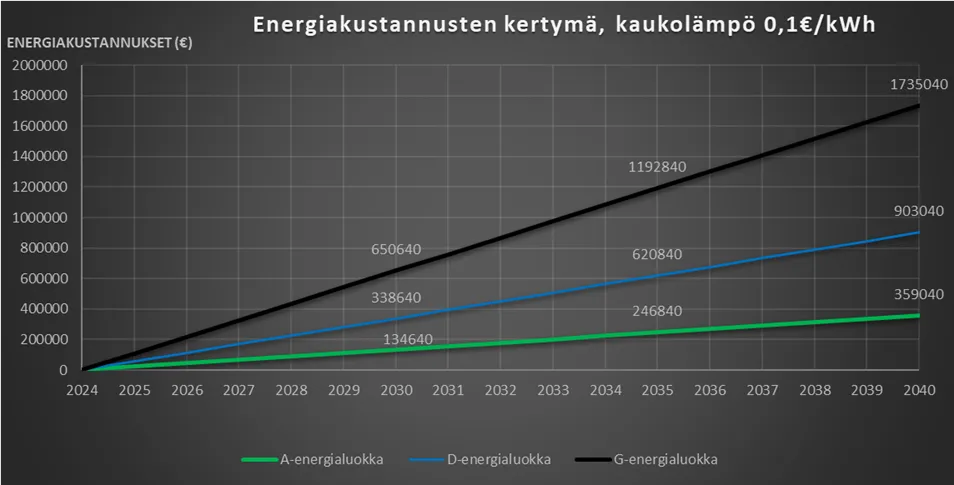
Cumulative energy costs of district-heated blocks of flats in 2024-2040.
Energy certificate for a block of flats and our other energy services
We can prepare an energy certificate for a block of flats cost-effectively and accurately. We also prepare energy certificates for other building types, as well as energy reports for all building types. If you wish, we can combine the preparation of the energy certificate for a block of flats with more extensive energy saving studies, which saves costs because the information needed for the energy certificate is already available as a basis. If there is no need for an energy certificate, we will of course also examine your housing company’s energy saving potential separately if you so wish. Through us you can also get profitability calculations for investments, help with applying for energy grants and other energy-related consulting.
Energy efficiency classes for blocks of flats
The energy efficiency classes for blocks of flats are presented in the table below. The energy efficiency class is determined by the E-value (E-luku), and there are energy efficiency classes A-G, where A is the best and G the worst. Intended-use category 2 for blocks of flats includes residential buildings with residential floors on at least three storeys. Old blocks of flats usually fall into worse energy classes than new ones. Perhaps the most significant factor behind this is that new blocks of flats are required to have at least an E-value of 90 and energy class B just to obtain a building permit in the first place. For old blocks of flats, an improvement in the energy class may be a condition for energy grants to be awarded. The energy grants are intended to accelerate the transformation of Finland’s building stock towards greater energy efficiency and lower emissions. Especially in old blocks of flats, small or large energy efficiency investments are often very profitable financially even without grants. The benefit of energy efficiency can show not only in lower maintenance charges but also in the value of the flats.
| Blocks of flats | |
|---|---|
| Energy efficiency class | E-value, kWh/(m²year) |
| A | E-value ≤ 75 |
| B | 76 ≤ E-value ≤ 100 |
| C | 101 ≤ E-value ≤ 130 |
| D | 131 ≤ E-value ≤ 160 |
| E | 161 ≤ E-value ≤ 190 |
| F | 191 ≤ E-value ≤ 240 |
| G | 241 ≤ E-value |
Energy efficiency classes for blocks of flats (intended-use category 2)
Energy certificate
The energy certificate is a document that shows a building’s energy efficiency. The energy certificate records the input values used to calculate the E-value and energy consumption. Some of these values are standard values, such as indoor temperatures and the building’s hours of use. However, a large share of the input values for the calculation is based on the design plans. Such information includes, for example, the thermal conductivity of the external walls, the heat recovery efficiency of the ventilation units and the type of heating system.
E-value
The E-value is an energy efficiency figure weighted by energy carrier factors, and its unit is kWhE/m2 per year. It thus expresses how much energy, weighted by energy carrier factors, is consumed per unit of the building’s floor area. The calculation of the E-value is governed by legislation and decrees, which also set out the energy carrier factors to be used. The energy carrier factors are 1.2 for electricity, 0.5 for district heating. 0.28 for district cooling, 1 for fossil fuels and 0.5 for renewable fuels. So if, for example, a building consumes 50 kWh of electricity and 60 kWh of district heating per square metre of heated net floor area per year, the E-value is 50 x 1.2 + 60 x 0.5 = 90 kWhE/m2 per year.
Energy report
The energy report (energiaselvitys) mainly concerns new construction. It is a more extensive set of documents than the energy certificate, and in addition to energy efficiency it must show, among other things, that indoor temperatures do not rise too high during warm periods in summer. The energy certificate is included in the energy report.